
Energy systems today are becoming more flexible, more compact, and more intelligent. From telecom base stations and solar setups to industrial backup systems, reliable energy storage is now a core requirement rather than an optional upgrade. As demand grows, choosing the right physical structure for battery storage becomes just as important as choosing the battery itself.
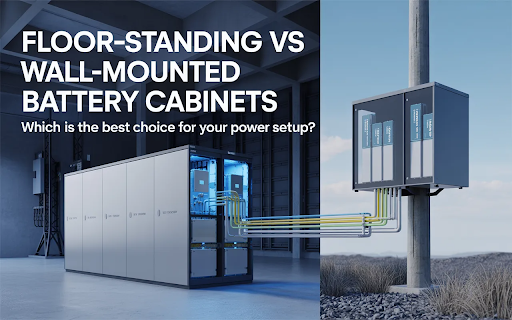
Two popular options in modern power systems are the Floor-standing battery cabinet and the Wall-mounted battery cabinet. Both serve the same basic purpose—storing and protecting energy—but they differ in installation style, capacity, space usage, and ideal applications. Understanding these differences can help you design a more efficient and reliable power setup.
Why Battery Cabinet Design Matters
Battery systems are not just about storing energy. They also need to be protected, organized, and maintained properly to ensure long-term performance.
A poorly chosen cabinet can lead to:
- Overheating and reduced battery life
- Difficult maintenance and poor accessibility
- Space inefficiency in installation areas
- Safety risks in outdoor environments
That’s why selecting the right cabinet design is critical for system stability and long-term efficiency.
What Is a Floor-Standing Battery Cabinet?
A Floor-standing battery cabinet is a standalone structure placed directly on the ground. It is designed to hold multiple battery modules and related power equipment in a secure, organized, and protected enclosure.
These cabinets are commonly used in:
- Telecom base stations
- Solar energy storage systems
- Industrial backup power setups
- Outdoor infrastructure projects
A typical example is the floor-standing base station battery cabinet, which is designed for high-capacity energy storage and stable outdoor performance.
Key features include:
- Large internal space for multiple battery modules
- Strong structural design for outdoor durability
- Integrated cooling and ventilation systems
- Easy maintenance access from front or rear panels
Because of its size and structure, this type of cabinet is ideal for medium to large-scale energy storage applications.
What Is a Wall-Mounted Battery Cabinet?
A Wall-mounted battery cabinet is a compact energy storage unit designed to be fixed onto walls or poles. It is often used in smaller installations where space is limited but reliable energy storage is still required.
These systems are commonly used in:
- Telecom poles and small base stations
- Urban infrastructure setups
- Small-scale solar systems
- Distributed energy networks
A good example is the wall-mounted pole-mounted base station battery cabinet, which is designed for flexible installation in tight or elevated spaces.
Key features include:
- Compact and lightweight structure
- Easy installation on walls or poles
- Space-saving design for urban environments
- Suitable for lower to medium energy capacity needs
This makes it a practical choice for locations where ground space is limited or unavailable.
Key Differences Between Floor-Standing and Wall-Mounted Cabinets
Although both cabinets serve similar functions, their design and use cases are quite different.
1. Installation Method
Floor-standing cabinets are installed directly on the ground and require a stable surface. Wall-mounted cabinets are fixed onto vertical structures such as walls or poles.
2. Capacity and Size
Floor-standing cabinets generally support larger battery capacities, making them suitable for heavy-duty applications. Wall-mounted cabinets are more compact and designed for smaller energy loads.
3. Space Requirements
Floor-standing units require dedicated floor space. Wall-mounted systems save space by using vertical installation, making them ideal for crowded or urban areas.
4. Maintenance Access
Floor-standing cabinets usually offer easier access for maintenance due to their larger structure. Wall-mounted cabinets may require more careful handling during servicing.
Floor-Standing Battery Cabinet: Strength and Capacity
The Floor-standing battery cabinet is designed for high-performance energy systems that require stability and large storage capacity. It is often the backbone of telecom base stations and industrial power systems.
Advantages include:
- High energy storage capacity
- Strong environmental protection
- Better cooling efficiency for large systems
- Suitable for continuous, high-load operation
This makes it ideal for applications where uninterrupted power supply is critical and system reliability is a top priority.
Wall-Mounted Battery Cabinet: Flexibility and Space Efficiency
The Wall-mounted battery cabinet focuses on flexibility and compact design. It is perfect for modern urban infrastructure where space is limited but energy storage is still required.
Advantages include:
- Space-saving installation
- Flexible mounting options (walls or poles)
- Lower structural footprint
- Ideal for distributed energy systems
This makes it especially useful for small telecom sites, smart city installations, and decentralized power systems.
Performance and Cooling Considerations
Cooling plays a major role in battery performance and lifespan.
Floor-standing cabinets typically offer:
- Larger airflow space
- Better heat dissipation systems
- Support for higher power loads
Wall-mounted cabinets, due to their compact design, rely on:
- Efficient internal airflow design
- Smaller but optimized cooling systems
- Lower heat generation due to smaller capacity
Both systems are designed to maintain safe operating temperatures, but floor-standing cabinets handle higher thermal loads more effectively.
Which One Is Better for Your Power Setup?
The answer depends on your specific energy needs.
Choose a Floor-standing battery cabinet if:
- You need large energy storage capacity
- Your system supports heavy or continuous loads
- You have enough ground space available
- You require long-term industrial or telecom stability
Choose a Wall-mounted battery cabinet if:
- Space is limited
- You need a compact installation
- Your energy requirements are moderate
- You are working with distributed or small-scale systems
Final Thoughts
Choosing between a Floor-standing battery cabinet and a Wall-mounted battery cabinet is not about which one is better overall—it’s about which one fits your specific power needs.
Floor-standing systems are powerful, scalable, and ideal for high-demand applications. Wall-mounted systems are compact, flexible, and perfect for space-constrained environments.
Both solutions play an important role in modern energy infrastructure. As energy systems continue to evolve toward smarter and more distributed designs, selecting the right cabinet type will be key to achieving efficiency, reliability, and long-term performance.