
Consider a high-end residential community project within an expanding urban area. The design is exquisite, the landscape beautiful, and all components meticulously laid out for creating a luxurious living environment. In spite of the sophistication, the process of developing a lighting system can pose an unexpected problem. This may result from the expense incurred during trenching, wiring, and utility coordination. As such, what initially appeared insignificant becomes an expensive and difficult issue that threatens the schedule.
This is precisely why Off-Grid Infrastructure Lighting represents an innovation in present-day construction. Rather than depending on a tedious process of connecting to an electricity supply, solar-powered systems allow for quick, efficient, and environmentally friendly solutions to be achieved within a shorter period. This method cuts out reliance on utilities while at the same time saving on operational expenses. For real estate developers who strive to create premium assets, this strategy offers significant benefits.
Why Are More Developers Choosing Solar Lighting Over Grid-Tied Systems?
The honest answer is that grid-tied outdoor lighting has always been more of a headache than it needs to be. Between utility approvals, underground wiring, and ongoing energy costs, it adds friction to projects that are already complex enough.
Off-Grid Infrastructure Lighting removes most of that friction. Here is what makes the difference in practice:
No Trenching, No Delays: Solar lighting systems are self-contained. There is no underground conduit to lay, no coordination with utility crews, and no waiting on approvals. For large sites, that alone can shave weeks off the installation schedule and tens of thousands off the budget.
Lights That Stay On: A grid-tied system goes dark when the utility grid has a problem. An off-grid system does not. It runs on stored solar energy, independently, every single night. For luxury residential buyers or commercial tenants, that kind of reliability is not a small thing.
Savings That Actually Add Up: Some off-grid systems cut upfront infrastructure costs by up to 65 percent compared to traditional wired alternatives. Remove the trenching, remove the energy bills, and reduce maintenance visits, and the numbers over a ten-year horizon look very different from what a conventional system delivers.
Design That Fits the Property: Premium developments have specific aesthetic expectations. Modern solar lighting comes with custom pole heights, clean fixture profiles, and adjustable output levels. It is flexible enough to match a high-spec design brief without looking like an afterthought.
A Genuine Green Credential: ESG requirements are not going away. Solar infrastructure lighting supports green building certifications, appeals to sustainability-focused buyers, and satisfies the kind of environmental benchmarks that institutional investors and lenders increasingly expect from new developments.
How the System Actually Works on Site
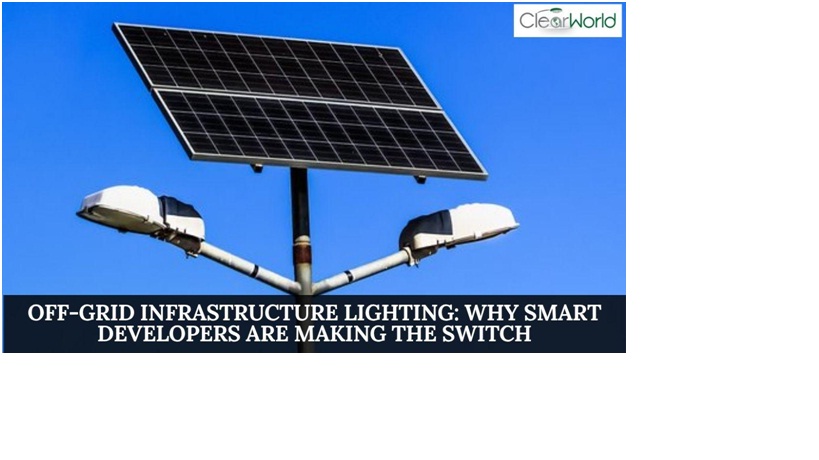
Each unit combines a solar panel, a lithium-ion battery, and an LED fixture into one weatherproof system. The panel charges the battery throughout the day. The battery powers the light through the night. Smart controls dim or brighten the output based on movement and ambient conditions, so energy is never wasted.
For sites with existing poles, retrofit solutions attach directly to the structure, with no new installation, no digging. For new builds, systems are sized to match the actual sun exposure and usage patterns of the site, not generic assumptions. And because each unit operates independently, scaling up or repositioning lights as the development grows is straightforward.
Are There Any Limitations to Think About?
As we consider solar lighting as one of many technologies, there are a few limitations related to this technology. Fortunately, most of these limitations can easily be managed through proper planning.
Dependence on the Sun: It needs sunlight in order to produce energy. With some shade present in some areas, proper planning is needed.
Initial Investment: The initial investment in each solar lamp is high compared to that of any other light source. However, considering installation expenses and savings on power bills, the cost is worth it.
Battery Life: Batteries in these lamps must be changed after some time. Lithium-ion batteries last a very long time, however. Therefore, battery change is infrequent.
Bulkiness of Design: Solar lamp poles may appear bulky due to solar cells. Nevertheless, some designs are made for luxury residences.
Conclusion
The case for Off-Grid Infrastructure Lighting has never been more straightforward. It cuts costs, removes installation headaches, supports sustainability goals, and delivers the kind of dependable outdoor lighting that premium developments need. For property developers who are tired of utility surprises and want infrastructure that works from day one, solar is no longer the alternative option. It is quietly becoming the obvious one.